Revolutionary Misfit

Dare to be Inspirational

  • Impact Mindfulness
    • The Movement
    • Impact over Interest
    • The Big US
    • Removing Impact Blinders
    • People Planet Universe
    • Revolutionary Misfit Creed
  • The Blog & Podcast
    • Blog Archive
    • World Changers Expat Podcast
    • The LA County Jail Series
    • Costa Rica Expat Tours
    • About the Author
  • Books
    • The Rev Misfit Manifesto
    • The Impact Revolution
    • Expat Mindfulness – The Book
    • Definitive Guide to CR Expat Living

From Revolutionary to Redeemer

February 28, 2014 by costaricaguy 1 Comment

revolutionary to redeemer

I just finished Zealot: The Life and Times of Jesus of Nazareth by Reza Aslan.

It is a deeply interesting and provocative read.

Like Aslan I came to Christ out of a longing to belong, but for different motivations.

His because he was a U.S. transplanted Iranian who wanted acceptance in a hostile new place.

I just wanted a girl.

In my early 20’s I was a wild child. That is, until one night at a party I met this tall, big brown eyed USC coed.

We continued our wild ways for a time until she told me she felt compelled to go to church. She had grown up as a Christian and she felt pulled to reverse direction (repent, in spiritual parlance).

Soon thereafter I was faced with a decision myself. Repent and accept Christ as Savior, or lose my girlfriend.

I repented.

And for the better part of the next two decades I lived the life of a borne-again Christian.

But my nature compelled me to question…even though I did so inside my head, since doing so openly would not go over so well with the brethren.

I was always drawn to the book of James. It seemed odd and out of place in the midst of Paul’s more popular epistles.

In fact, James in many ways seemed to contradict what Paul was saying.

So much so, in fact, that the great protestant reformer, Martin Luther, wanted to de-canonize the book written by Jesus’ own brother altogether.

I read in Zealot about how this odd book that is hidden among-st Paul’s many faith without works exhortations could hold important truths as to how a Jerusalem based revolutionary movement became a dominant world-wide religion in a relatively short period of time.

You see, James was the brother of Jesus (not cousin…brother). Perhaps there is no New Testament figure who was closer to the man himself…the historic man who actually lived in the land the Romans called Palestine.

Whereas Paul came on to the scene a good many years after Jesus’ death on the cross.

There are dramatic parallels to what Jesus said and what the book of James proclaims.

That is, faith-based works, especially those directed to the poor, are what God seeks.

And, like Jesus, James had some pretty heavy admonishments for the rich.

The Jewish Mosaic Law also features prominent in James, as it did in the words of Christ.

Whereas Paul tends to dismiss the importance of the Law altogether.

The premise, or conclusion, of Aslan’s Zealot is that Jesus, the historic man, was a revolutionary. He was a Jew who headed a messianic movement directed specifically at Jews. His goal was to topple the prevailing order. And order in which the synagogue and its rulers were becoming increasingly wealthy at the expense of the poor. And order in which the government of Rome manipulated them at will.

Jesus’ goal was to cleanse the temple…to reestablish not a spiritual heavenly kingdom, but a kingdom right here on this earth, in that specific place (Jerusalem) and for one specific people…the Jews.

He failed and was crucified by the Romans for treason.

That was the only reason the Romans crucified people.

So, how did he go from revolutionary to redeemer and instigator of one of the world’s greatest religions?

And all this happened in the few decades that passed after his death.

One thing that Aslan points out that resonated with me is that the contrast one can observe between the book of James and the epistles of Paul at least partially reveals the answer.

Paul was a Hellenistic and educated Jew. He took the movement from Jerusalem to the Greek world. And in the process he transformed the message of Christ from one of revolution against Rome to redemption and salvation of the world.

A message that resonated much better with the Greeks and Romans, which of course allowed the message to take hold.

So much so, that the Romans eventually made it their own official religion.

Do you think Jesus the Jewish revolutionary really ever envisioned such a thing?

Now why would Paul do that?

Well, you’ll have to admit it’s a pretty cool thing to have accomplished.

Actually, that’s a question that Aslan fails to answer.

Aslan’s book does not purport to solve all the mysteries of the universe, but it does make one think…

and question…

and that’s a good thing.

So, where does all this leave me…from a faith perspective?

I’ve written before that I believe one should question authoritative propositions.

And in the U.S. there’s hardly less of an authoritative proposition as the one that says the bible is inerrant and must be accepted…lock, stock and barrel.

Despite its obvious inconsistencies.

Like those between the book of James and the epistles of Paul.

And since we all want to belong, we accept that proposition, even when the facts potentially suggest otherwise.

I consider myself a follower of Jesus, the historic revolutionary.

But not a follower of Paul.

Paul may well have fabricated a heavenly version of Jesus Christ who is presented as the faith-based redeemer of those pre-chosen by God.

That’s a worldview that can have dangerously divisive repercussions…

as it certainly has.

But the historic Jesus of Nazareth may well have been more along the lines of an impact-focused revolutionary.

One whose message would probably not resonate so well with the religious-right in this current day and age.

He would definitely be considered a progressive.

But that also happens to be the Jesus that is currently more in line with my personal world view.

And yes, Reza Aslan, formerly a Christian, is now a Muslim…

just wanted to get that out in the open.

Even so, he has a well-educated and informed thing or two to say that’s worth listening to.

image credit: Digo_Souza via Compfight cc

Filed Under: Removing Impact Blinders Tagged With: jesus, removing impact blinders, reza aslan, zealot

Things We Take for Granted

February 27, 2014 by costaricaguy Leave a Comment

don't take water for granted

We take a lot of things for granted…don’t we?

Things like clean water (the kind that fills our toilets), clean air, food on the table, a faithful and supportive spouse…etc.

I had to throw in that last one since I’ve had a bit of personal trouble with it.

The other day I returned home from a short trip and discovered something not all that pleasant.

I had forgotten to pay the water bill and it was cut. Not a drop could be coaxed out of the llave (or, spigot).

I did still have a bit of clean water in the john, but who wants to brush their teeth with that?

Well, I quickly paid the bill  (online) and reported it, but then it proceeded to take almost two days for AyA to get the water flowing again.

Two days!

And during that time I suffered.

There is something degrading about not having access to water…right inside the comforts of your home. Even though all I had to do was walk a block to where I could purchase plenty of it for a nominal sum.

Woe is me right.

I know there might be someone who reads this and thinks to him or her self…that’s nothing, during hurricane what’s-her-name we were without water for a friggin week!

Yea, and how did it feel?

Food is one thing. Plenty of us could probably stand to go a bit of time without that.

Water is a whole nuther non-laughing matter.

You can go about 3 weeks without food. But only 3 days without water…or so I read this morning on the internet.

Oh, 3 minutes without air…in case you’re wondering.

Why it’s called the rule of 3’s.

Do you know that in some places on this earth, there is NO readily access to clean and safe water, whatsoever.

Just check out these water facts from the site charity:water.

I read a moving article today by charity:water founder (Scott Harrison) entitled The Last Walk for Water.

It is about a 13-year old girl sent out to get water, which entailed a long (10-mile), gruesome and dangerous walk in the blazing heat of Ethiopia. But the clay pot she was carrying fell and broke.

Her humiliation at failing at her task motivated her to hang herself from a nearby tree.

As the title to this post suggests, it’s easy for us to take things for granted.

When we have them readily available at our disposal. It is almost unimaginable that they wouldn’t be.

But for many not having water (or food, or shelter) is a daily experience.

I started this blog on the premise that a good life is an impactful one. I talk a lot about that.

But, as we all know, actions can speak louder than words.

So, I want this blog to not only talk about impact mindfulness, but practice it as well.

In that light I have launched a modest charity:water campaign.

The goal is a meager $1,000.

But once success is achieved with that, we will certainly “up the anty.”

The campaign is Don’t Take Water for Granted.

In fact, impact mindfulness suggests that we don’t take anything for granted.

But water is certainly a great place to start.

Please consider a donation.

Filed Under: Impact over Interest Tagged With: charity:water, impact over interest

Religiously Inspired Hatred

February 26, 2014 by costaricaguy Leave a Comment

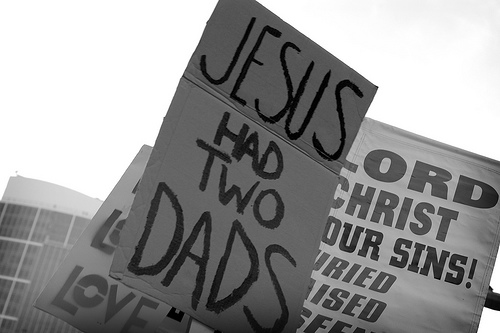
religiously inspired hatred

According to the good book, God hates the gays…

and the divorcees, and adulterers, and drunkards and a whole lot of others whose behavior often resembles, well, me (maybe you too?).

Funny thing is, Jesus never said a word about or against gays.

Yea there were a few passages inserted long after Jesus shed his mortal coil…

but Jesus himself…mute, mum, not a word.

He did have a thing or two to say about divorcees, however (ouch!).

It seems that gays are finally getting some well-deserved political respect.

And that scares the living shit out of bible-thumpers.

So much so that there’s currently a rallying cry for the adoption of so-called religious freedom laws that would allow businesses to refuse to do business with gays under the guise of protecting sincerely-held religious beliefs.

I vaguely remember, because I was very young at the time, the segregated south.

Years before blacks had also achieved some measure of political respect, via being recognized as actual human beings…

as opposed to just chattel.

A whole lot of good Christian folk were a bit upset about that. They were able to coax state legislatures to pass what became known as Jim Crow laws. Laws that allowed discrimination on the basis of, you guessed it, sincerely-held and arguably “religious” beliefs…chiefly the belief that whites were a superior race and that blacks should be kept separate and apart from it.

So, my question is this. If we’re going to use the bible as our guide to enactment of laws, why stop with the gays?

Why not re-enact the entire Old Testament Law…after all, Jesus himself said that not one “jot or tittle” should be disregarded, or something like that.

Let’s start stoning those nasty adulterers and divorcees (I’ll just remain in Costa Rica until further notice in that case).

And of course, then we can do much more than just discriminate against gays, we can do as the Ugandans do…get rid of them for good!

I read somewhere that the draconian law recently passed in Uganda (a country where the President actually said on the news that gays were “disgusting”) was also scriptural-ly motivated.

Or, we can look to another source for law. The one that begins with that well-known phrase of…

All men [and women] are created equal.

Shouldn’t that apply to gay ones and straight ones…even divorcees and adultering ones?

Sometimes the impact of a law can get lost behind the facade of a good constitutionally based rationalization.

Jim Crow laws were rationalized along the lines of “protecting” black Americans by separating them from whites.

Really?

And in Arizona, a state where Christian owned businesses can already freely discriminate against gays (since sexual-orientation is not on the no-discrimination laundry list), the reason for the law is protecting religious belief?

What’s this really about?

Sounds to me like it’s a lot less about religious freedom and a lot more about religiously inspired hatred.

Seems that we’ve been there before…didn’t we learn anything?

image credit: The Searcher via Compfight cc

Filed Under: Removing Impact Blinders Tagged With: gay rights, removing impact blinders

The Great Immigration Debate

February 22, 2014 by costaricaguy Leave a Comment

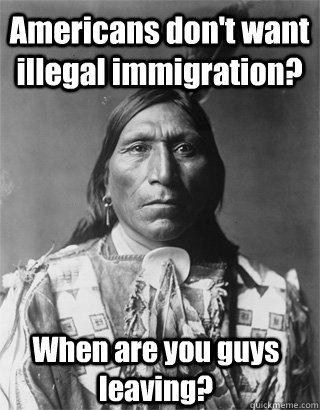
the great immigration debate

I came across a similar image to the one on the left yesterday in a Facebook wall post.

I saw a snarky comment that someone had left under it pointing out in protest to the message in the image that the immigration debate is focused on “illegal” immigration.

[side note: Actually, the one I saw on Facebook omitted the word illegal. I couldn’t find that version for this post.]

So I made the following (admittedly equally snarky) comment…

I think the point is that other than the general ethnicity of the dude in the image, we’re all historically illegal.

So, why the snark?

Well, I’ll tell you why…

But I’ll start with a question…

The U.S. has four borders, right? Well, technically, two aren’t “borders”, but oceans, and one is Canada.

But it is that fourth one that stirs up all the fuss…the southern one.

Why is that?

Perhaps because that one is the one where on the other side, people are way different.

They sing “America the Beautiful” in a foreign tongue for god’s sakes!

Their differences make them a perceived threat.

Does anyone ever talk about building a wall to keep out the Canadians?

Once upon a time one of those other “borders” got invaded by folks who were way different than the ones currently occupying the land now called North America.

What happened next is pretty much a matter of settled history.

We, being us predominantly white Anglo-Saxons Protestants, took what had been theirs for a very long time.

Now was it “legal” for us to do so?

I guess that technically there was no settled law of the land at the time…but from the perspective of the current inhabitants…

I believe not.

Now does the fact that our ancestors were all “illegal” (in the sense of taking what wasn’t theirs) make us, 100’s of years later, also illegal?

I guess not.

BUT…

Isn’t that the same argument that can be made for the descendants of those who came here illegally from that pesky border to the south who now ask for the right to be made legally…

legal?

Okay, arguments against tortured arguments aside…

Moral for the great immigration debate, at least from my perspective…

Isn’t it best to always err on the side of compassion?

Filed Under: The Big US Tagged With: immigration, the big us

There Just Aren’t Enough Rocks

February 21, 2014 by costaricaguy 2 Comments

there aren't enough rocks

From time to time you’ll see a movie related post in here.

It’s not that I’m so much of a movie aficionado…we do have one theater (or, cine) here in Perez Zeledon. They will only show the scheduled movie if at least four people show up for it. During weekdays you could end up paying for one or more “ghost companions.”

The joys of living in small-town, Costa Rica!

But occasionally a movie will really get hold of me. That happened years ago with this unique little film called Forrest Gump.

There was one scene in particular that always provoked a lot of emotion, but for a long time I kinda didn’t fully understand why.

So one day, also years ago, I put some thought into it.

Here’s what I came up with…

Was flipping through channels yesterday and there on number 347, or something, was Forrest Gump, one of my favorite movies of all time. I have probably seen it a dozen times, but each time there are certain scenes that really get to me.

I guess I identify with Forrest in ways, feeling like a sort of “detached observer” at times, but nevertheless finding myself unwittingly in the middle of awkward and difficult situations.

Gump handled those with an amazing degree of dexterity despite his surface level deficiency in the smarts department.

I would say that his approach to life displayed quite a bit of what one might call, Gump-tion.

He was also prone to some pretty good one-liners, usually attributed to momma.

I guess mommas are the source of a lot of our inherited wisdom.

I really like the scene where his beloved Jenny has returned, after many years of destructive wandering, to Greenbow, Alabama to be reunited with her lifelong friend.

They are walking along a dirt road when they stumble upon Jenny’s childhood home, a place of bad memories for her. Jenny begins to throw rocks at the abandoned and broken-down old house. When she exhausts the supply readily available she collapses and is consoled by Forrest, who in his movie narrator dual role makes the profound assertion that…

Sometimes, I guess, there just aren’t enough rocks.

That quote always seemed to convey deep meaning and I would find myself nodding my head in agreement, muttering in my mind, “you know, Forrest, you’re right, sometimes there just aren’t.”

But if you asked me point-blank what exactly Forrest meant by the statement, I would likely be hard-pressed to give a concise and cogent answer.

So in this post, I thought I would try to make some sense of why that particular Gump zinger was so meaningful to me.

Most of us harbor memories in life that aren’t so great. These can turn into resentments. If you hold those inside, as Jenny had apparently done, there may not be enough “rocks” to throw in the attempt to release those inner feelings of rage.

I know. I have a few myself.

Sometimes the thought of all that coming to the surface scares the hell out of me.

Green-tinted visions of Hulk-ish rage come to mind.

So best just to keep them buried deep down inside.

But is that really healthy?

I believe for Jenny her road to destruction ended with that pile of rocks. She’d been throwing them, in one way or another, all her adult life and I guess they just ran out.

The throwing ended with the realization that living her life in reaction to the past is a dead-end street.

How about you?

Still searching for rocks to throw?

Getting near the bottom of your pile?

Take a clue from Forrest Gump, drop those two in your hand you might be thinking of hurling just now…

make peace with your past and move on.

Link to Movie Clip

image credit: BryDeeC via Compfight cc

Filed Under: Removing Impact Blinders Tagged With: forrest gump, removing impact blinders

How to Become Extraordinary

February 19, 2014 by costaricaguy Leave a Comment

how to become extraordinary

We live in a time when the quality of being extraordinary seems to be inextricably linked to degree of fame and fortune.

And of course not everyone can achieve fame and fortune.

But that’s what we really want…deep down. So we elevate those who do achieve it to that coveted status of…

extraordinary.

I’m going to suggest, however, that maybe there’s a better way…a more truthful how to become extraordinary.

I’ll explain with a story about a very young blogger.

It’s the story of a little girl in Pakistan. The village where she grew as a child was under the grip of an oppressive regime that refused to allow girls to go to school. In protest, she decided to blog about it. That did not make her popular with the regime, but it did quickly gain attention in other parts of the world.

The regime decided to put an end to the girl and her blog. A gunman boarded a school bus and fired a shot into her face. She survived.

And now she is doing more damage to that regime’s repressive ideology than that bullet could do to her body and will.

The little girl’s name was Malala Yousafzai. The regime, The Taliban.

I posted the other day that a star on the Walk of Fame takes talent and a man on the moon genius, but a blog that matters, only a sincere desire to make a difference.

That comment was discussed on the popular podcast, Unmistakable Creative.

But the idea that seemed to emanate from the discussion was that only extraordinary people can do extraordinary things.

No one would argue against the notion that Malala is an extraordinary little girl. At 16 she is currently in Syria in support of the inhumane conditions that refugees from the ongoing civil war are experiencing, especially the most vulnerable of those refugees, the children.

But before she was recognized, Malala was by all intents and purposes, an ordinary child from a remote village in a northwestern Pakistanian province.

No one would likely have acknowledged her had it not been for one important thing…

impact.

Her impact was to bring to the light of the world an almost unimaginable idea…that little girls like her would be denied the opportunity to go to school because of some radical religious-based ideology.

Who could have known that her blog would be picked up by the New York Times? That she would go one to be twice nominated for the Nobel Peace Prize (the youngest person ever to receive such a nomination).

We all start out as ordinary. There are no exceptions. Some may have distinct advantages. But if you go back far enough, you will find that “they” were once quite ordinary.

Sure, we may erect mythologies that support the idea of our heroes being extraordinary from birth. But I’ll make a radical suggestion that those are exactly that…myths.

What truly makes us extraordinary is our impact upon the world…not fame and fortune.

Fame and fortune may be a byproduct of that impact…but it’s not what makes one extraordinary.

Not in my opinion at least.

There are quite a few in our society who have achieved fame and fortune for one reason or the other, not related to impact. And I wouldn’t consider any of them extraordinary.

How far-reaching does that impact need to be before the moniker of extraordinary can be bestowed?

I would suggest not very much at all.

One person, perhaps?

You see, I believe in this day and age where “going viral” and “15 minutes of fame” are considered more important than, well, everything, we tend to get mixed up about extraordinary.

It’s not the eBook that may have gotten noticed by the right person and thus “viralized” that makes the author extraordinary…it’s the impact of the author’s message.

And impact is more about motive than it is about talent, or luck (fame and fortune require a bit of both).

That is, if you have a heartfelt desire to change the world for the better, someone will notice…someone will be impacted, even if your prose contains a few typos and run-ons. Even if your blog was not designed by an all-star.

Even if you never “go viral.”

The truth of the matter is that….

we’re all ordinary by creation, but we become extraordinary by impact.

image credit: nancymergybrower via Compfight cc

Filed Under: Impact over Interest Tagged With: impact over interest, malala

  • « Previous Page
  • 1
  • …
  • 34
  • 35
  • 36
  • 37
  • 38
  • …
  • 46
  • Next Page »

Connect with RM

Revolutionary Misfit social media connections...

  • Facebook
  • Pinterest
  • Tumblr
  • Twitter
  • Impact Mindfulness
  • The Blog & Podcast
  • Books

Copyright © 2026 · Parallax Pro Theme on Genesis Framework · WordPress · Log in